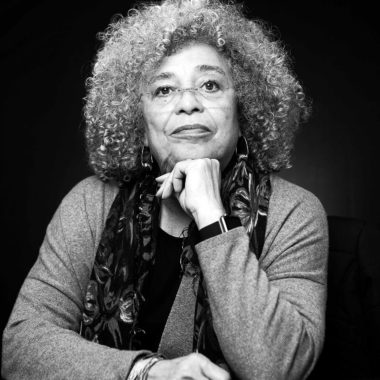
Introduction: Our guest today is Angela Davis, one of the world’s most important voices for justice. The philosopher and activist came to prominence in the 1960s. Six decades later, Davis is still on the frontlines fighting for equality and freedom on a range of issues – from prison abolition to racial justice and gender rights. On March 20, 2024, the iconic activist and scholar came to the Sydney Goldstein Theater in San Francisco to talk about her new book, Abolition, Volume 1, with Hilton Als, New Yorker staff writer and a professor at the University of California Berkeley. The evening was a benefit for Marcus Books, the oldest Black-owned independent bookstore in the United States. Join us now for a conversation with Angela Davis.
Hilton Als: Now, I’m very happy Angela to be here and let’s talk a little bit about the bookstore and what it means to have a bookstore like this in the culture.
Angela Davis: Well, first of all, good evening everyone. Thank you so much for coming out, and thank you Hilton for agreeing to participate in this conversation.
Hilton Als: Thrilled to be here.
Angela Davis: Yeah. And, you should know that this entire event is a benefit for Marcus Books.
Hilton Als: Yes.
Angela Davis: Which is the oldest Black bookstore in the country.
And before we move on to the conversation, I would like to point out that, Blanche Richardson, who’s the owner of the bookstore now, I worked with her for decades it seems. I was colleagues with her mother. We taught together at San Francisco State University, Rae Richardson. And her father, Julian Richardson, was a very close friend of my father’s, because he’s from Birmingham, Alabama.
So I’m always more than happy to do work that supports the bookstore. We need independent bookstores. We need Black bookstores.
Hilton Als: Yes. The first bookstore I ever went to, the first bookstore I ever bought books was called The Liberation Bookshop [in Harlem]. That’s right. And my mother would ask me at Christmas time, what was I reading?
And I’d tell her, and she would get on the subway and go to The Liberation Bookstore to support it. She would not go to Barnes and Noble, she would not go to Macy’s. She would go to this bookstore. So there’s a family connection to reading and to the culture of reading. I think that’s what you’re expressing as well.
Angela Davis: Oh, absolutely. Yeah. So instead of getting your books from Amazon, you can order them also from Marcus books. Marcus has an online presence. And independent bookstores really need to be supported. Particularly in this era.
Hilton Als: Yes. I want to point out that “Abolished” which is the latest collection–
Angela Davis: Abolition.
Hilton Als: I’m sorry, Abolition. I don’t know what–
Angela Davis: Which is also a mandate to abolish. So it could have easily been called abolished.
Hilton Als: It’s when I’m nervous, I mispronounce everything. I will not be nervous soon. Abolition, there is volume one available and there will be volume two on the way.
The ideas that you’ve expressed in these essays and throughout your life as a thinker and activist show up here over and over again as points of departure for the reader, talking about myself and other people who follow the essays and one of the essays that changed my life was reflections on the Black woman’s role in the slave community, which you published in 1970, and you were incarcerated at the time that you were writing this piece.
I know that you shy away from, it’s not glorifying you when I say I don’t know anyone who else would’ve had that concentration to produce something so brilliant in such a horrible situation. The importance of this essay was about resistance and love as a kind of resistance. The ways in which Black women were able to emotionally hold the family together in contradiction to a lot of things that the slave owners felt that they should be able to do, separate families and husbands and wives and so on.
So can we talk about that essay and the germs of the idea that you started to build on from there? And then of course the autobiography followed that, but I’m very interested in that text and in this book.
Angela Davis: Well, that was actually the first piece I’d ever published. And, writing helped me center myself when I was in jail. And, nowadays when I look at the amazing intellectual work that is being done by people in prison, it’s clear that when one finds oneself in such a situation, a situation of unfreedom, a context within which you don’t get to make the decisions that you normally make in the course of living one’s life: you can’t decide when you are going to eat. You can’t decide what time you’re going to wake up. You can’t decide how you are going to spend your day, pretty much.
And so intellectual work, thinking, reading, writing becomes really the only possibility to experience prison. To experience freedom in prison. To experience the domain of freedom. And so I can identify with all of the people, the women, the men, the trans people who are in prison now, who really need to be free.
Because, there are a number, there are so many reasons why we should abolish prisons and why those who are inside should be liberated. But one of the most pressing reasons is because people who are behind bars and who have dedicated themselves to learning, to thinking, to writing, are more equipped than most people who inhabit the free world, the so-called free world, to address the problems confronting us today.
Hilton Als: Because it’s a kind of enforced concentration, right?
That you are living in a penal system where your mind is the only thing that you own.
Angela Davis: Absolutely. But we who inhabit the free world don’t realize how much people who are incarcerated, how much time they spend thinking about the issues that plague our world.
And I know when I was in jail, I was thinking about what was going on in the movement. I was thinking about the fact that there was a great deal of male supremacy. That’s one of the reasons why I wrote that book about Black women during slavery. It was an attempt to address what were current issues in our movement by looking at their historical roots and looking at the historical evolution.
Hilton Als: One of the incredibly moving things in the autobiography is when the women started to ask you questions, they were starting to read, and you knew that it wasn’t because of you but in addition to what you were going through that they were asking you questions about politics, and they were looking for ways in which to express themselves, to express solidarity, and to express community.
You wrote this book with the help of our wonderful friend, Toni Morrison, as your editor. And, one story that she told, always about your generosity, she said, before I was Toni Morrison and I was with Angela Davis in Sweden, and we would be in an airport and someone would come up to her and say, my brother is incarcerated. And she said, Angela would always stop and say, where is he? How long will he be there? Et cetera. And she said, and I felt like a worm when I said, Angela, come on, we have to catch the flight.
Angela Davis: I know she talked about the fact that during the time that she edited my book and so many others, she had not yet acquired the leadership that established her place in the world. So she said, I was Angela’s security while we traveled all over the world.
Hilton Als: Well, you brought up something very interesting in your last, when you were just talking about the sort of masculinist impulse and you were reluctant about the autobiographical form, not only because of your youth, but because you were feeling that it was a sort of “masculine form.”
Can you talk to us a little bit about that? And you disrupted it, obviously.
Angela Davis: Well, I tried to, I don’t know whether I was entirely successful.
Hilton Als: I’d say so.
Angela Davis: But the autobiography as a genre, is a very masculinist genre. It’s a very individualist, individualistic genre. It’s about presenting one’s life to the world for all of the lessons it might offer to others.
And I said, that’s not what I want to do. I don’t think my life is that special. I see myself as a part of a larger community. I see myself as a part of a movement, as a part of a struggle, and I don’t want to disassociate my ideas from those of the community.
And yeah, Toni and I had some arguments about whether it made sense as a person. I was 28-years old, I had just gotten out of jail when she approached me with the prospect of writing an autobiography. And I said, who writes an autobiography in their twenties? It makes no sense at all. But eventually she persuaded me and we talked about other models, the slave narrative, for example.
Which is a collective model. Although of course, when one thinks about the most well-known slave narrative, Frederick Douglass. There are some obvious masculinist qualities there.
But she persuaded me that it could be a book about my experiences in the movement. Which is what I turned out to write. Which is what I felt most comfortable writing about, rather than thinking that I had something special as an individual to offer.
Hilton Als: Well one of the points of, I would say, education for me in the book and in your writing in general, is the order that you talk about in terms of joining the Communist Party, that it would take, that it wasn’t a fly-by-night decision and that one had to be strong mentally and physically for this fight.
Can you tell us a little bit about that fight and how being incarcerated propelled you further into this movement?
Angela Davis: Yeah. I’ve always been a person who’s required community, organizations. Some people don’t necessarily like to affiliate with organizations. One of my closest friends, June Jordan, whom I’m especially missing during this period in which we’re reflecting on what is happening in Gaza, and attempting to develop solidarity in relation to Palestine.
I remember that June was always very reluctant to affiliate with an organization. Yet with her poetry, she had this enormous impact on politics and on people’s hearts at the same time.
So yeah, I’m not saying everybody has to be an organizational person, but I’ve always felt that I’m lacking something if I don’t have a community. And that community is a source of ideas. It’s a source of the impulse to move forward. I can’t imagine feeling entirely alone.
And I’ve said many times that even during the period when I was in jail and facing the death penalty, it was my community that kept me feeling strong.
I’m not a person who is by nature courageous, although everybody always calls me courageous. That’s one of the adjectives. And I said, you know something, I am really not very courageous. If I think about what is in my heart, in my soul, I think of other people.
Hilton Als: But it’s interesting when, I’m just going to tell the young writers in the audience, it is impossible, nearly impossible to interview Angela Davis, where she says, “I.” You know how hard this is as writers, she doesn’t say, “I,” she says, well, when “the community” or when “the movement,” or, and you want, say, Angela, come on, like Toni, right?
She doesn’t, it’s not in her soul to say that, and this idea of activism has been with you as long as this idea of community, right?
And here’s one story, that Toni herself could never get over. It’s in the autobiography. And Angela saw two dogs that were going to kill each other. And Angela was eight, nine?
And she couldn’t stand the fact that the adults were standing around not doing anything about this potential bloodbath. And she separated the mad dogs. I know. So I’m not buying the courageous part, but I do want to say that,
Angela Davis: I really love dogs. I love humans as well.
Hilton Als: That one of the things that is so powerful to me about your writing and about your soul is how you write about and connect the reality of the body to activism. And I’m going to read a little bit from 1998’s Blues Legacies and Black Feminism, where you write:
“Like most forms of popular music, African American blues lyrics talk about love.
“What is distinctive about the blues, however, particularly in relation to other American popular musical forms of the 1920s and 30s, is their intellectual independence and representational freedom. One of the most obvious ways in which blues lyrics deviated from that era’s established, popular musical culture was their provocative and pervasive sexual, including homosexual, imagery.”
And the word that stands out here for me, Angela, is representational freedom. And this will go back to this idea of abolition and this idea of separating from systematic murder of people. Can we talk a little bit about that? Because you go into it quite a bit in your 2015 book, Freedom is a Constant Struggle, which is a great book, this representational freedom. How do we not only represent freedom, but how do we feel it?
Angela Davis: Well, let’s first take the question of how blues as a genre developed. Blues constituted the first genre of people of African descent in this part of the world, in this country, in relation to freedom.
So it was a music of freedom, but the freedom that was offered to people at the end of slavery was not the freedom that had been imagined.
As a matter of fact, there was more unfreedom. As Du Bois pointed out, there was no economic freedom. There was no political freedom. The ways in which freedom began to express itself had to do with the struggle for education. Building new institutions, but also and very importantly, sexuality was perhaps the most felt experience of freedom.
When people began to be able to make choices about their sexual partners. And those partnerships weren’t always heterosexual. If one looks at blues songs by Ma Rainey and Bessie Smith, you know, Ma Rainey’s “Prove It on Me Blues:” “went out last night with a bunch of my friends / they must have been women because I don’t like no men.”
I mean, this is in the 1920s. And so what I try to argue in that book is that love and sexuality bore the burden of freedom.
So all of those other realms in which freedom was not to be had immediately, not to be expressed economically, politically, and socially in so many ways.
But there was freedom in the realm of love, freedom in the realm of sexuality. And that’s why the blues constitutes such an important genre, and that representational freedom that is oftentimes not interpreted as broadly as it should be.
Some people say, I don’t like to listen to the blues because it’s only about some woman singing about some man who has left her. But if you think more deeply about it, it is the first expression of individuality, a kind of individuality that is not polluted by individualism.
And we could spend the rest of this time talking about that, Hilton.
Hilton Als: But I think it’s important what you’re saying in terms of the voice, right?
And how does the voice of resistance declare itself? There are many different ways. And you’ve been speaking a lot recently about understanding the artist, and how the artist’s work is a form of resistance to the “normative voice.” And I think that when I look at your work, you’re speaking a lot about bodies.
And if there are bodies, there are voices. And how do we hear and how do we understand what people are saying? I look to you often for that kind of clarity.
Angela Davis: Well, I’ve actually been trying to think about art and politics, art and struggle for a very long time. As a matter of fact, that is why I wrote that book, Blues Legacies and, what is it called?
Blues Legacies and Black Feminism. The reason I hesitate is because at the time I wanted to put feminism in the plural. It was supposed to be called “Blues Legacies and Black Feminisms.” But, Random House didn’t like that title. So I always hesitate now, is it the title that’s in my mind, or is it the title that’s in the book?
Hilton Als: Exactly. The quote goes on when you say that those aspects of lived love relationships that were not compatible with the dominant ethereal ideology of love were largely banished from the established, popular musical culture.
Yet these very themes pervade the blues. And what I feel when I read this book and when I read you often is that you are finding ways in which the stop gaps become the voices – that the marginalized voices, as you said, not paying attention to it in the general culture, I think it makes for a subversive voice.
But can you tell us something about this form of resistance, not just in music, but the forms of resistance that you’ve been coming to hear more and more and more as you travel and speak and talk.
Angela Davis: Well, one point that I should probably make in connection with the conversation on abolition and the most recent book is that if one wants to attempt to access the history of practices of incarceration, racist inspired practices of incarceration from the point of view of those who experienced it, then one has to look in places like the blues.
As a matter of fact, I looked at the work of Black women blues singers, and I was amazed at the extent to which subjects that are generally banned from the realm of, well, were banned, from the realm of popular music and other genres, pervaded the blues.
I don’t know how many songs about jailhouse blues and being in prison. And so I thought when I was working on that book that it might actually be possible to write a history of racist inspired incarceration by using blues lyrics.
And of course there have been some wonderful scholars who’ve recently moved in that direction.
Hilton Als: Can you go back to that point a little bit, to tell us more about the ways in which you were looking at the lyrics as it almost mirrored about incarceration or freedom?
Angela Davis: Well, in the research that I’ve tried to do and I said “I.”
Hilton Als: Blessings.
Angela Davis: On the history of the prison in this country and the role that racism has played in constituting that history, what we discover is that the most dominant characteristic of the institution is its invisibility, is its hidden character, and hidden, not only in terms of not being acknowledged in the popular discourse, but hidden in the sense of carrying the sense of this shame that people have internalized the invisibility of this institution by feeling very reluctant to even admit that they’ve been behind bars.
Now I’m talking about a situation that really existed in I would say at least up until the eighties and the nineties when anti prison activists began to do the kind of organizing that has made it possible for people who have spent time in jail and in prison, to feel as if they can be proud of what they have accomplished.
As a matter of fact, in the most recent book, Abolition. Practices, what is it called? I can never remember the titles of my books, Politics Practices Promises.
Hilton Als: Yes. I think that’s a facet of modesty really, when you can’t remember the title of your own book.
Angela Davis: I don’t spend that much time thinking about the titles.
I know when I wrote Women, Race and Class, I was also teaching a course at San Francisco State, which was called “Women Class and Race.” I could never remember which was the book and which was the course.
Hilton Als: It’s fascinating what you’re saying about this point of pride, about what you are able to accomplish in degrading situations, I think that partly what you are uprooting and unrooting is the history of degradation.
The number of Black bodies that are in jail, legalized genocide. And it’s one of the things that I’ve learned from reading you, I did not have that much knowledge about it because jail was jail, right. It was what we were taught was the bad place, that you would go there if you were bad.
We were all criminalized in some way, and we didn’t know it. And that’s what you were bringing to light.
Angela Davis: In the eighties, the nineties, especially when work began to accelerate within an abolitionist frame. I can remember when there were 500,000 people in prison.
I can remember when there were a little over 200,000. And we were talking about the fact that there are 200,000 people in prison in the United States of America. And then it became 500,000. And then it became a million. I can remember when we achieved that goal, that milestone.
And then a million and a half. Many of us were saying, how is it that most people can do nothing? When the numbers of people who are being banished to these prisons that are becoming increasingly repressive keep rising and also the disproportionate number of Black people, especially Black men.
But then there came a point when the proportionate numbers of women, and especially women of color, indigenous women, Black women, Latina women, when those numbers began to rise. And then of course there was Michelle Alexander’s book, The New Jim Crow, which was on the New York Times bestsellers’ list.
And that marked a moment when people began to look seriously at this issue of what came to be called mass incarceration. Although, many of us now argue that we can’t simply be opposed to mass incarceration, and I think Michelle Alexander says the same thing now, that we have to rethink what it might mean to achieve safety and security in our society.
And that means thinking beyond the prison. That means that the institution of the prison is an outmoded attempt to address problems of harm. And as a matter of fact, we see that it’s not even about addressing issues of harm. The prison serves as a kind of place to deposit people who have the most pressing problems in our society.
So what we need to do is solve those problems as a matter of fact, as opposed to getting rid of the people who have the problems so that we can pretend that the problems don’t exist.
Hilton Als: Burying people alive.
Angela Davis: Exactly right. So that’s the argument of abolition. The argument of abolition is not so much just getting rid of the institutions, of the prison and the police.
It’s about creating a society that no longer needs to rely on these institutions so permeated with racism, these institutions that thrive on repression, to depend on them in order to feel safe. So what would really make us safe? What would really make us feel secure? Then of course, that’s a huge question.
Hilton Als: It’s a diverse question.
Angela Davis: So what do we need in order to feel safe and secure?
Hilton Als: I don’t know.
Angela Davis: Well, I would say, first of all,
Hilton Als: I’m looking at you.
Angela Davis: I’m sure that people who live in the streets would say, I need housing. We need housing for everyone. And I’m sure many people would agree that we need education, we need free education. For everyone. And we need free healthcare.
And how can we feel secure without those basic institutions that will satisfy the needs that we have as humans who cohabit this planet? We need a planet.
And so that means that we have to think about the fact that every time we drink a glass of water, a bottle of water, and that plastic bottle ends up in the ocean, that is destroying the environment that the fish need to survive, and without the fish there can be no ocean, and without the ocean, there can be no planet.
I’m just suggesting that we have to think a little bit. We can’t take things for granted in the way the people who run government and the people who, especially the people who run the corporations.
Hilton Als: There have been bodies that I’ve lost and recently a very close friend of mine who was victimized by this penal system and victimized by poverty and he died. And he was 67-years old.
And increasingly, the numbers that I get of people, Black men, friends, 63, 67, 64, 65, these are not ordinary numbers for folks to live now. Or not live. And I think to your point about not having a planet to come home to, none of these men had a home. They had been incarcerated at some point, they were unhoused at some point.
Part of the systematic destruction of any person is to not give them the feeling that they have a home and that they have a place. Is that partly what is going on now? That the systematic destruction of these bodies has a lot to do with enforced alienation.
Angela Davis: Yeah. And it’s also about profit. It’s also the question of what the resources that are produced by workers on this planet, how they are used, and they should be used for the benefit of those who inhabit this planet, and not only for the benefit of the humans who inhabit this planet. And instead they’re subordinated to the demands of profit.
And this is why so many people are in prison in the first place. Because it’s much easier to, as I said before, to just get rid of the people who have the problems that are produced by the fact that we live under a system that values profit before life. Before human life and before the lives of the other animals with whom we, we are animals, aren’t we?
We should share this planet, and plant life as well. That’s the source. I don’t want to be reductionist and say that every single problem comes down to capitalism. But I think I will say that.
And I’ll say racial capitalism as well. And when we look at what’s happening right now in Palestine.
Hilton Als: I was just about to go there, but you go there.
Angela Davis: No. I’ll let you go there.
Hilton Als: One of the things that was profound in the time that we spent together was I asked you about your students and you said, “it’s a dialectical relationship, I’m learning from them”. And I then asked you about, sometimes students feel that they, because of their education, they’re catapulted past their parents and family and so on. And I asked you how you felt about that, and you said, it angers me because you can always build a bridge between who you are and who your people are, who your community is.
And I think those bridges are what we’re looking for so desperately now. And I wanted to ask you about those bridges. I know that you spend a lot of time traveling and observing, and you told me, I won’t share it with the audience, but you told me about a trip to Israel, that you had gone to Palestine and to Israel with a women’s group.
Angela Davis: Yeah. Actually, it was to Palestine. And it was with a group of women of color and indigenous women scholar activists.
Hilton Als: Okay. Is it possible, are these bridges possible?
Angela Davis: I think so. And I think education is so central to the project of freedom. Education should be the practice of freedom.
Education should help us figure out how we live our lives with and in freedom. But oftentimes education teaches people binary notions of what exists, contradictions that are not reconcilable.
And now of course we’ve seen a discourse on antisemitism emerge, which defines antisemitism in ways that makes it possible to incorporate antisemitism into the struggles against other forms of racism. I grew up recognizing that struggles against antisemitism were always organic to struggles against racism. And that now somehow we’re being told that if we engage in campaigns against settler colonialism and Israel, and if we challenge the government of Israel, that somehow that’s antisemitic.
Hilton Als: But this is,
Angela Davis: Let me just say one other thing.
Hilton Als: Please.
Angela Davis: I’d like to think through these questions more deeply than we are encouraged to. And I’ve been thinking a lot about nation states, and about the fact that like the prison as an institution, the nation state was created in and through history.
And just as we argue that the prison is not a permanent institution that should address the social and political issues that lead people to believe that they need to incarcerate people, so the nation state shouldn’t be imagined as the permanent way in which we organize the human community in the world.
So, as I try to imagine a world without jails and prisons, I also try to imagine a world in which borders will not be the central way of marking the boundaries between communities of humans. Which also leads me to think that the nation state is organized violence, what are the main institutions of the state?
The police. The military. I want to urge all of us to think more deeply about ways to address these problems without having to rely on institutions of repression, on institutions of violence.
And particularly since we see what has happened in Gaza over the last several months, tens of thousands of people have been killed and people are starving.
And somehow we have to figure out how to make community with those who are suffering in such ways. Having said that, I’d like to point out that we are really indebted to Jewish organizations like Jewish Voices for Peace. And if not now, because they are leading us in this battle, their very leadership allows us to recognize that the best way to think about abolishing antisemitism is also about getting rid of Islamophobia and also getting rid of the ways in which the Palestinian people for more than 75 years have been forced to experience the destruction of their homes.
Hilton Als: And this is something that you’ve been thinking about for many years.
Your friend, Jean Genet, was thinking about it and trying to articulate what that difference felt like, spiritually and economically. And now it’s come to pass, as you said, where people are starving, and people are dying. Is there, in this, the police state that you mentioned, is there a way to talk about the real harm, the real structural harm, that’s done to individuals, or are we not seeing each other as individuals anymore?
Angela Davis: I think we need to think in terms of communities, because if one looks at how the Palestinian people are being represented, through the forces that are attempting to destroy them. They’re not being represented as individuals. And I think individuality is important.
When I say that I’m opposed to individualism, I’m not saying that we shouldn’t all attempt to give expression to
Hilton Als: No, your work bears that.
Angela Davis: Individualism militates against individuality. Let me put it that way. And, yeah, there are people like Jean Genet, I really miss him during this period.
I miss June Jordan, who wrote, “I was born a Black woman, but now I am become Palestinian.” I really wish that she were alive still to see the upsurge of support all over the world. And this is unprecedented.
Hilton Als: And her work was not an act of ventriloquism, it was an act of being, of speaking the soul. A lot of people I feel often are giving lip service or language that is appropriate. And this goes back to your love and understanding of artists, is that it can’t be controlled, right? It can’t be bought what someone like June Jordan was doing, what Toni was doing, what you’re doing. These are things that can’t be commodified, they can only be believed and trusted.
Angela Davis: Well, I can’t compare myself to my friend Toni Morrison because I think,
Hilton Als: It’s a different line, but it’s a similar,
Angela Davis: This gives us the opportunity to say something about the specificity of artists who are able oftentimes to tell us how it feels to want to be free before we figure out what we will have to do in order to make that a reality. And I always go back to Nina Simone’s song: “I Wish I Knew How It Would Feel to Be Free.” In the process of hearing her sing that, we get a glimpse of what it might feel like to be free.
Hilton Als: We get a glimpse of it talking to you.
Angela Davis: Well, thank you.
I don’t feel that those are my talents. I’ve always been, I’ve always loved ideas. And so I try to work with ideas and I know working with art, working with the heart., is different.
Hilton Als: But it’s not different. If you’re ready to receive.
Angela Davis: Maybe you’re right about that.
Hilton Als: Oh goodness. We got very involved in our conversation. We have a few moments.
Angela Davis: We forgot to look at the time.
Hilton Als: Yes, yes. We have a few moments for questions.
Angela Davis: Yeah. And maybe we can bring the lights up because it’s always really bizarre talking to people whom you can’t see.
City Arts & Lectures: This first question comes from the second floor in the back.
Hilton Als: Can you just raise your hand? Oh, she has on the white I jumper?
Audience Member 1: Okay. Hi Angela. Nice to meet you. I’m Tara. One thing that really sticks with me is when you said that Palestine is the litmus test for liberal politics, and that’s something that I feel like I’m always trying to get people in my communities to see.
And I would like to hear your perspective on what an independent school in San Francisco that is Quaker driven and says the values of simplicity, integrity, peace, stewardship, and so forth: what should they be doing about what’s going on in Palestine right now? What should the educators at such an institution be doing, especially given if we have Palestinian students?
Angela Davis: Well, thank you so much for the question. First of all, I should tell you that I borrowed that notion that Palestine is a litmus test from June Jordan. Whenever I use that, I said as June Jordan always reminded us, but of course, when it gets reported, where social media and they use the shortest possible version of it.
Hilton Als: They TikTok your words.
Angela Davis: But the whole question of talking about Palestine as a litmus test is in order to allow us to think about the relationship between the struggle for justice for Palestine and the broadest struggle for justice for everyone in the world.
In many ways, what is happening now reminds me of the struggle to undo apartheid in South Africa. People who were involved in so many different social movements all around the world embrace the struggle to end apartheid in South Africa because we felt that if we could bring down that system in South Africa, it would mean a step forward for all of us, wherever we were in the world, who were struggling for justice and freedom and equality.
And that I think is how we should think about what is going on in Palestine today. It’s not a specific struggle, as specific as it may be, because it also pushes us to think about what is happening in Haiti for example, what is happening in the Sudan.
And because of the fact that people all over the world are standing up in support of solidarity with Palestine. In this country, the government of this country is in the minority if you think about what is happening all over the world. And I think that, while there may be some people who have backward ideas about what that might mean, I think the majority of people want to incorporate that movement into a struggle to create a better world for everyone. Because that is what it is all about.
Hilton Als: And you mentioned something that was, that’s very dear to you and close to my heart as well, which is that education is such a fundamental tool. Do people know where Palestine is to begin with? How did this happen? How do we educate the youth?
And I think we have beginnings with things to understand that teaching is not a job, it’s a vocation. And that you have to approach it with love and persistence. And I think that’s what she’s asking.
Angela Davis: And thanks so much for telling us a little bit about the school. And it interests me because when I went to high school in New York, coming from Birmingham, Alabama, I was a part of a Quaker program.
It was called an exchange program where black students from the south went to the north and lived with white families, we always said, well, where are the white students from the north going to the south, living with Black families? Just very briefly, unfortunately we don’t have a lot of time for an extended conversation, but I think teachers, wherever they are, do their best when they assist their students to discover their own potential, their own passion.
What is it that they really love? And then how do they use that in order to help create a better world.
Hilton Als: That’s right.
Angela Davis: That is what education is supposed to do, I think.
Hilton Als: To enlighten the soul. I have to just tell you a fun fact, is that I live in New York across the street from where Angela went to high school.
So I consider it a very lucky omen. And sometimes when I see the students in the summer graduating and they’re very excited and it’s a very racially and sexually mixed place, I will take a little video of them on their way to graduation and send it to Angela and she says, oh, so many memories. I think we have time for one more question.
City Arts & Lectures: This next question’s in the back of the orchestra in the center.
Audience Member 2: Hi. I wanted to tell you about my niece who lives in Delaware. She won an art competition and she’s a great artist and she drew a picture of you and one of your quotes. She hung it up because she won the art competition in her school, in the state of Delaware. And she hung it up and the administration came out and said, oh no, you have to take that down. And she sat behind it the whole night and said, no, I will not take it down. And they said, if you don’t, then you will not be allowed to go to any of the graduation ceremonies.
And so after that, the next morning all the students came out and they protested and the administration came out and said, okay, you can come to the graduation ceremonies, but we are not going to hang it back up. And they said, that is not good enough. You will hang it back up, or we will stay out here and none of us will go to the graduation ceremony.
And sure enough, they hung it back up. So I just really wanted you to know, your voice is heard all the way to Delaware with 16 and 17 and 18-year-old kids.
Hilton Als: Beautiful.
Angela Davis: Yeah. As embarrassed as I am to be at the center of situations like that, it really moves me to hear stories of young people who learn how they can make change. This is how change happens when people come together and stand together and resist together, and struggle together.
Thank you, Angela. We send you all our love, all of us. Thank you.
Transcribed by Gabriel Hawkins